A series of reported attacks on Saudi Arabia's aviation infrastructure has triggered widespread flight cancellations, heightened airspace warnings and uncertainty for international travellers. Airlines and private aviation operators are reassessing how to move passengers safely through one of the world's most important aviation regions.
Saudi Arabia and the Gulf
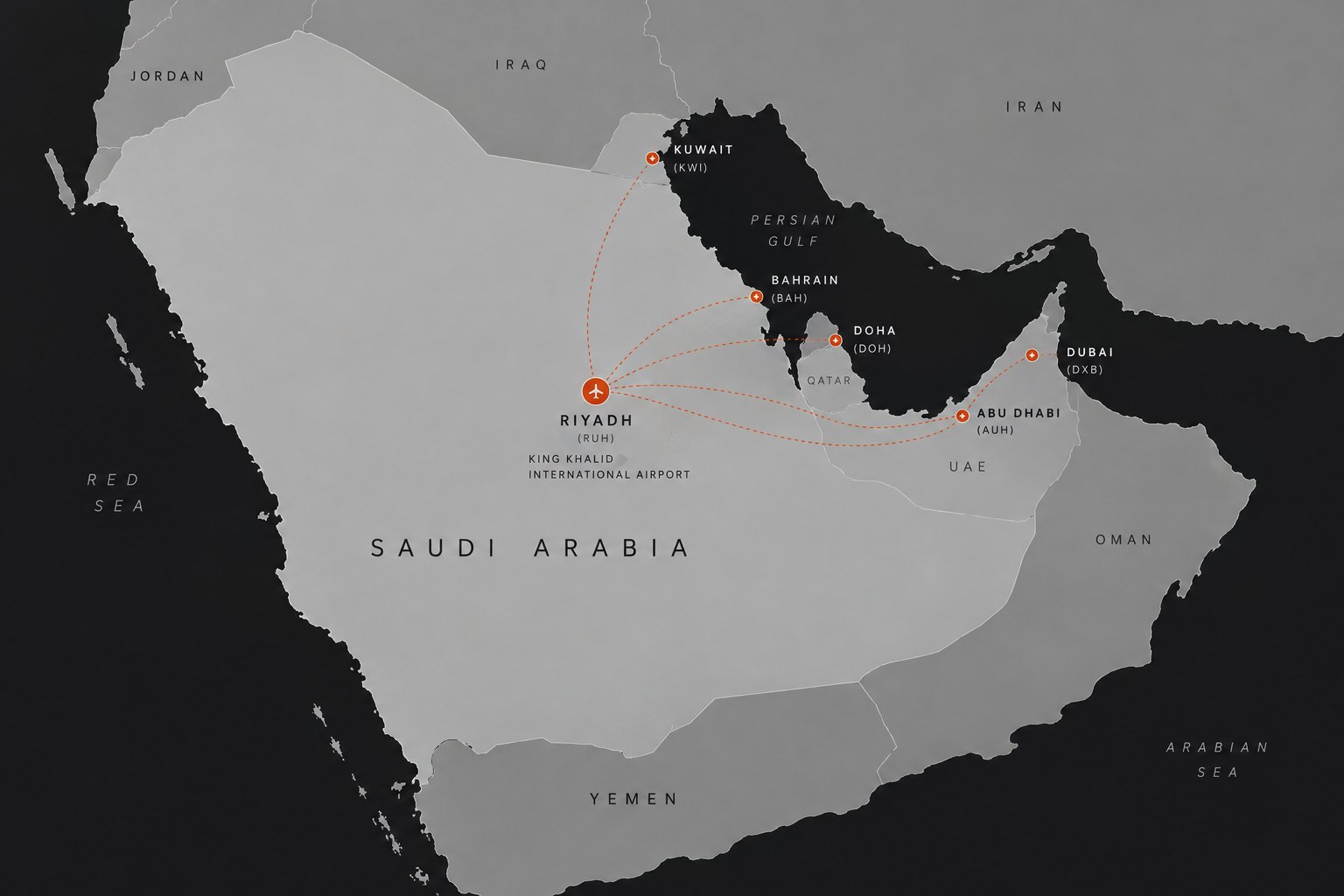
- RIYADH, KING KHALID INTERNATIONAL AIRPORT: The airport faces serious disruption, with continuing uncertainty over the resumption of normal services. Reports of attacks on the airport over the weekend of 10 and 11 October were followed by extensive flight cancellations. Reports available for the morning of 12 October indicate that cancellations continue. For passengers, the consequences are immediate: cancelled journeys, missed connections and limited visibility over onward travel. For airlines, the challenge is more complex, requiring them to balance schedules against changing security assessments and operational restrictions.
- REGIONAL CONTEXT: The crisis comes amid heightened tensions involving Saudi Arabia, Yemen's Houthi movement and the wider confrontation involving Iran. The reported attacks have brought renewed scrutiny of the safety of regional airspace.
- AIR CORRIDORS: Restrictions over Saudi Arabia affect routes linking Europe, Asia and Africa, but do not mean the whole Gulf is closed. Saudi Arabia lies on important air corridors between the three continents. Restrictions can force carriers to consider longer routes, alternate airports, additional fuel requirements and aircraft repositioning. Nevertheless, disruption in Riyadh does not establish that every airport in the Gulf is closed; conditions vary by location and change over time.
Regulatory Warnings
- FAA: NOTAM A0056/26 warns of military activity and potential satellite-navigation interference in the Jeddah Flight Information Region. The US Federal Aviation Administration notice is effective from 11 October and applies to applicable operators. In addition to direct threats from missiles or drones, interference with satellite navigation can increase cockpit workload and complicate routing decisions.
- EASA: An updated conflict-zone advisory recommends avoidance of specified Saudi airspace sectors and caution elsewhere. The European Union Aviation Safety Agency's advisory is referenced as CZIB-2026-09-R1.
- RIYADH AIRPORT NOTICE: A published airport notice indicated temporary unavailability at King Khalid International Airport spanning 11–12 October. Its live status must be checked against the current official NOTAM feed before any flight planning.
Timeline: 9–12 October 2026
- 9 October: EASA expands its Saudi airspace warning as carriers adjust or cancel services.
- 10 October: Reports emerge of a serious attack on King Khalid International Airport, with casualties and damage reported.
- 11 October: Further reported attacks and disruption; the FAA issues a new Saudi airspace warning and airport unavailability is notified.
- 12 October: Extensive cancellations continue to affect Riyadh as airlines and operators review resumption options.
Earlier Gulf Crises
- PRECEDENT: Previous episodes show how quickly regional instability can affect aircraft, crews and passengers far beyond the immediate area of conflict. In October 2024, Iranian missile attacks against Israel prompted airlines to divert flights and adjust routes across the Middle East. In June 2025, missile activity involving Iran and Qatar led to temporary restrictions across several Gulf airspaces.
- ACCESS: Elevated risk does not automatically mean a whole region is inaccessible. The safety and feasibility of a flight depend on the precise airspace, route, airport, operator, regulatory permissions and prevailing threat assessment.
Private Charter
- FLEXIBILITY: Private aviation can offer options when scheduled services are unavailable, but it is not exempt from airspace closures or security risks. Charter can be particularly useful for essential business travellers, families and groups, with aircraft sourced around specific departure requirements and suitable alternate airports. Any journey remains subject to operator acceptance, airport access, regulatory permissions and insurance.
- ALTERNATE DEPARTURES: An onward charter from a safe, operational airport may in some cases be more practical than departing from an affected hub. Ground movements and international border crossings must also be assessed before being proposed.
Traveller Preparation
- INDIVIDUALS: Travellers should follow official local guidance and maintain contact with their airline. Keep passports, entry authorisations and residence permits accessible, alongside secure copies. For a potential charter enquiry, prepare each passenger's full name, nationality, date of birth, present location, preferred destination, contact details and any medical or mobility requirements.
- BUSINESSES: Organisations should establish the location and welfare of personnel now. Identify those with essential travel needs and consider contingency arrangements before options narrow.
Oryx Global Aviation
Oryx Global Aviation supports private jet charter, commercial group charter and specialist aviation arrangements. During a crisis, the priority is not simply finding an aircraft, but determining whether a proposed journey can be completed safely, legally and reliably using current airspace intelligence and operator coordination.
For charter enquiries and contingency planning: www.oryxglobalaviation.com
Source and verification: prepared from the 12 October 2026 morning briefing and historical aviation-security reporting. References include FAA NOTAM A0056/26, EASA CZIB-2026-09-R1, airport NOTAM reporting and Reuters coverage. This article is not a live dispatch clearance. Confirm every current NOTAM, restriction and incident detail with primary authorities before operational use or republication.